
An older house can offer mature landscaping, established neighborhoods, durable materials, and details that newer construction rarely reproduces. To evaluate an older home before buying, however, buyers must separate harmless age from expensive deterioration and determine whether past upgrades actually improved the property.
The first visit should establish questions, not provide reassurance. A disciplined pre-offer property review can help buyers compare visible condition, seller records, likely repair costs, and unresolved issues before enthusiasm turns into a commitment.
Age Is Context, Not a Defect by Itself
A house does not become unsuitable simply because it is old. A well-maintained property built decades ago may be more dependable than a newer home with neglected drainage, rushed renovations, or failing systems.
The useful question is how the home has aged. Look for evidence that owners corrected problems when they appeared, replaced components before failure, and used appropriate methods rather than covering damage with cosmetic work.
Original features also need context. Wood windows, plaster walls, masonry, and older flooring may remain serviceable when maintained properly. Replacing them automatically can waste money, while assuming every original component is sound can create a different problem.
Condition matters more than age, but age changes what buyers should investigate and how much uncertainty they should include in the budget.
Cosmetic Updates Can Create False Confidence
Older homes often receive visible improvements before they are listed. New flooring, modern light fixtures, painted cabinets, and updated hardware can make the property feel thoroughly renovated even when the most expensive components remain unchanged.
These upgrades are not necessarily a problem. They become misleading only when buyers assume that a refreshed interior means the roof, structure, electrical service, plumbing, drainage, and heating systems have received the same level of attention.
Ask the seller which improvements were completed, when the work occurred, and whether permits, invoices, warranties, or contractor records are available. A detailed history helps separate documented improvements from general claims that the property has been “updated.”
Appearance should guide interest, not confidence. The condition of an older home becomes clearer only after buyers look beyond the finishes and identify what has been repaired, replaced, maintained, or left for the next owner.
Evaluate an Older Home by Systems, Not Surfaces
Fresh paint and updated fixtures can make an older property feel renovated without changing the roof, wiring, supply lines, sewer connection, foundation, or heating equipment. Buyers should identify which improvements are structural or mechanical and which are mainly visual.
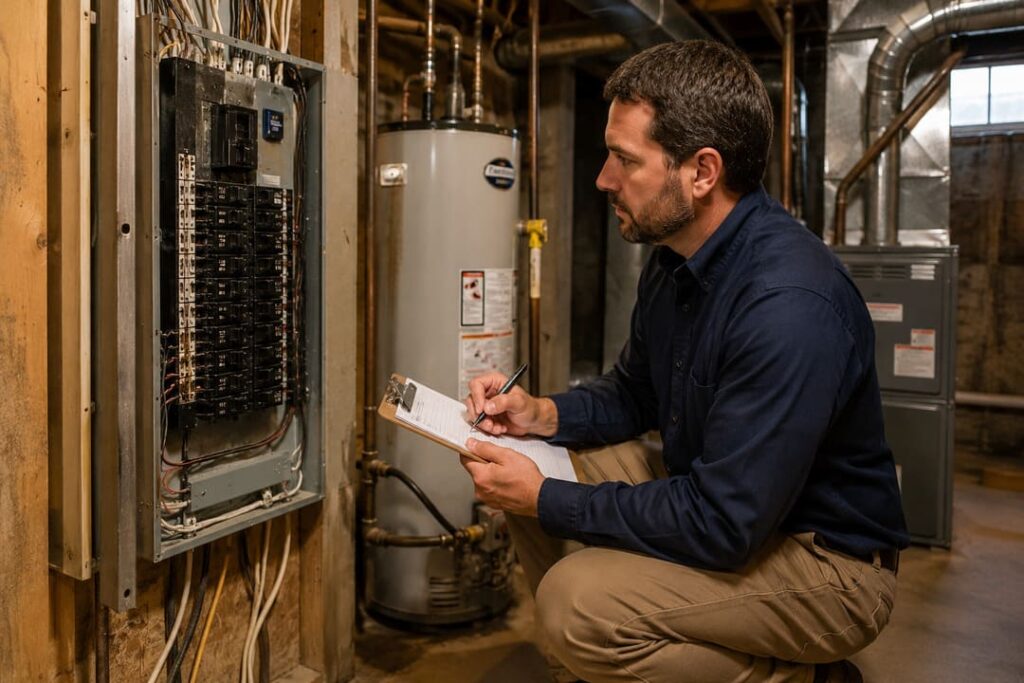
A professional inspection is the starting point. The independent inspection process can reveal visible defects and indicate when a roofer, electrician, plumber, structural engineer, chimney specialist, pest professional, or sewer contractor should investigate further.
Use the home’s major systems to organize the review:
| Area to evaluate | Evidence to request or observe | Cost question to answer |
|---|---|---|
| Roof and drainage | Installation date, leaks, flashing, gutters, downspouts | How soon could repair or replacement be needed? |
| Foundation and structure | Cracks, movement, uneven framing, moisture patterns | Is the condition stable or still changing? |
| Electrical system | Panel type, service capacity, wiring updates, permits | Can the system safely support current use? |
| Plumbing and sewer | Pipe materials, leaks, pressure, drain performance | Are failures likely to require disruptive work? |
| Heating and cooling | Equipment age, service records, distribution condition | Will comfort require repair, replacement, or redesign? |
| Exterior envelope | Siding, windows, masonry, grading, penetrations | Where can water enter or become trapped? |
The table should produce follow-up questions, not instant conclusions. One aging component may be manageable; several near-term replacements can change the affordability of the entire purchase.
Water and Structure Tell the Longest Story
Water is often more revealing than dated décor. Stains, musty odors, efflorescence, damaged trim, soft wood, peeling finishes, or repeated patches can point to roof leaks, plumbing failures, poor grading, foundation seepage, or inadequate ventilation.
Inspect how water moves around the property. Gutters should discharge away from the foundation, soil should not direct runoff toward the house, and basement or crawl-space conditions should be examined rather than dismissed as normal for an old building.
Structural movement also requires interpretation. Minor settling may be old and stable, while widening cracks, displaced masonry, sticking openings, or noticeably changing floor levels may deserve specialist review.
Moisture patterns deserve priority because repairing the visible damage without correcting the source allows decay, pests, and indoor-air problems to continue.
Old Systems Need Dates, Records, and Capacity
Ask when major systems were installed, who completed the work, and whether permits or invoices are available. “Updated” is too vague to support a buying decision. A partial electrical upgrade, for example, may leave older wiring elsewhere in the house.
Capacity matters alongside condition. The electrical service may function but lack room for modern appliances. The heating system may operate but distribute heat unevenly. Old plumbing may deliver water today while remaining vulnerable to corrosion or restricted flow.
Renovations need the same scrutiny. Compare finished spaces with permits, disclosures, and visible construction quality. Additions, converted attics, finished basements, removed walls, and relocated kitchens can affect structure, safety, insurance, appraisal, and future resale.
Documentation reduces uncertainty, although records do not replace inspection. Missing paperwork is not automatic proof of defective work, but it should prevent buyers from treating an improvement as fully verified.
Environmental and Specialty Checks May Be Necessary
A standard inspection does not test every material or hidden condition. The home’s age, location, construction, and planned renovations may justify separate evaluations for lead-based paint, radon, asbestos-containing materials, sewer lines, wells, septic systems, chimneys, pests, or underground tanks.
For most pre-1978 housing, federal rules require disclosure of known lead-based paint information and generally provide buyers an opportunity to conduct a lead inspection or risk assessment. The lead disclosure requirements do not guarantee that the home is lead-free, so buyers planning disruptive renovations may need qualified testing and lead-safe work practices.
Choose specialty inspections based on credible risk rather than ordering every available test. The inspector’s findings, seller records, local housing patterns, and advice from qualified professionals should determine where deeper review is justified.
Unknown conditions need a price. If a concern cannot be resolved before the inspection deadline, the buyer must decide whether the remaining uncertainty fits the contract protections, repair budget, and personal risk tolerance.
Price the Next Five Years Before Deciding
Convert the findings into a time-based ownership plan. Separate immediate safety or financing issues from work likely within one year, projects that may arise within several years, and optional improvements that can wait.
Then obtain realistic estimates for the largest concerns. Do not assume that a seller credit will cover the full project or that every improvement can be completed gradually. Some repairs interact, and opening walls or replacing one system may expose additional work.
The strongest older-home purchase is not the property with a flawless report. It is the one whose condition is understood, whose major risks have been investigated, and whose likely repairs leave adequate cash after closing.
Buyers who evaluate an older home carefully can preserve its character without inheriting a repair schedule they cannot support. Age can bring lasting value, but only when the buyer understands the house that exists rather than the renovated version imagined during the showing.
FAQ’s
Is an older home automatically more expensive to maintain?
No. Maintenance depends on condition, previous upgrades, materials, climate, and ownership history. A well-maintained older property may require fewer immediate repairs than a newer home that has been neglected.
Should buyers hire an inspector who specializes in older homes?
A professional familiar with older construction may better recognize period-specific systems, materials, and repair methods. Buyers should still arrange qualified specialty evaluations when the general inspection identifies concerns outside the inspector’s scope.
Can seller disclosures replace a home inspection?
No. Disclosures generally reflect known information and local requirements, while an independent inspection evaluates visible conditions for the buyer. Neither process guarantees that every hidden or future problem will be identified.